

Paris, France – Would-be entrepreneurs need cash to launch new businesses, but countries are far from equal when it comes to funding young, innovative and growth-oriented companies, according to a new OECD report.
Venture capitalists in Israel allocate more financing to young companies than any other country in the OECD, with the equivalent of 0.18% of GDP dedicated to seed, start-up and early development capital. The United States, Sweden and Finland are among the other leading providers of venture capital, and are not surprisingly also among the most entrepreneurial nations.
These are among the insights in the inaugural edition of Entrepreneurship at a Glance 2011, which gives an overview of entrepreneurship in OECD countries. Using indicators developed with the European Union’s statistical arm Eurostat, as well as those from national statistics offices, the report shows how access to finance, market conditions, regulatory frameworks and cultural perceptions can boost or harm entrepreneurial activity.
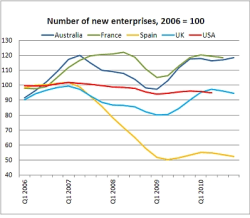
New data on enterprise creations and bankruptcies shows the major impact that the economic and financial crisis has had on entrepreneurial activity. After a significant decrease in the second half of 2008, the number of new enterprises started to recover around the first half of2009 inmost countries. However, by the second quarter of 2010, the number of newly created enterprises was still below its pre-crisis level in most countries.
The impact of the crisis was particularly long-lasting in Denmark and Spain, where the number of new firms being created during 2010 was still well below the high point before the crisis, but also in Finland, Germany, the Netherlands and the United States.
At the other end of the scale, entrepreneurship in some countries, like Australia and France, and to a lesser extent the United Kingdom, has bounced back from the crisis, with the number of firms being created actually higher in 2010 than it was at the pre-crisis peak.
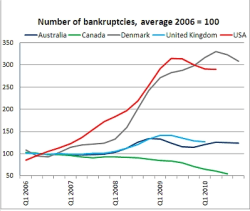
Similar trends are apparent for the number of bankruptcy procedures, which increased considerably across the OECD area over the 2008-09 period and continued at high levels through the second quarter of 2010. This was most pronounced in the United States, which saw a radical spike in bankruptcy procedures during the crisis and had yet to return to anything near pre-crisis levels by late-2010, when the number of bankruptcies was still hovering at nearly three times pre-crisis levels.
National culture affects the attitude that individuals have towards entrepreneurship, the likelihood of choosing entrepreneurship as a career, the ambitions to succeed and to start again after a failure, or the support provided to family and relatives planning to set up a business, according to the report.
People in the Nordic countries and the United States have the most favourable image of entrepreneurs, with more than 70% of those surveyed saying they viewed entrepreneurs positively, according to a survey of adults in 36 countries. At the other end of the scale, only one person in three expressed a positive image of entrepreneurs in Eastern European and Asian countries surveyed, including Hungary, Poland, the Slovak Republic, Japan and Korea.
A special chapter of the report measures green entrepreneurship, with Sweden, Finland, Spain and Italy standing out among European countries studied, alongside New Zealand and Brazil, which also display exceptionally dynamic performance.
Indicators on women entrepreneurs show that there are no major differences in the way male or female business owners perceive obstacles to starting a business or growing it. Men and women entrepreneurs agree that obstacles facing start-ups include legal and administrative matters, developing contacts with customers and access to finance. Subsequently, the obstacles to success come from the level of competition, business costs and the state of the economy.

 Oipol & Oijust
It’s amazing to visit this web page and reading the views of all friends concerning this piece of writing, while I am also keen of getting experience. click through the next page